Internationale ham- en radiocommunicatiebeurs Dirage 2026

DIRAGE

DIRAGE staat voor DIesters RAdio GEbeuren. Onder deze benaming organiseert UBA-DST sinds 1986 haar jaarlijkse beurs voor radioamateurs waar zowel tweedehands- als nieuw materiaal voor radioamateurs te koop wordt aangeboden. In de beginjaren was DIRAGE een sterk lokaal gericht evenement waar vooral de clubleden hun overbodig geworden hammateriaal probeerden kwijt te geraken, we waren toen al tevreden met een honderdtal bezoekers. De voortdurende groei van zowel de hoeveelheid materiaal als het bezoekersaantal dwong ons om meerdere malen naar een grotere lokatie te verhuizen, tot we in 2007 tot de vaststelling kwamen dat Diest te klein geworden was voor ons evenement.

De verhuis in 2008 naar een moderne en ruime lokatie was voor UBA-DST meteen ook een uitnodiging om van het oude, vertrouwde concept van DIRAGE af te stappen en onze hambeurs frisser en aantrekkelijker te maken.

Een grotere diversiteit van het aangeboden tweedehands materiaal, een uitgebreid gamma van nieuwe amateurtoestellen en antennes, de kans om tijdens een voordracht met demonstratie een nieuwe mode/materiaal van onze hobby te leren kennen, alsook het feit dat we aanverwante hobby’s de kans geven zich te tonen …. maken dat DIRAGE een begrip geworden is in ON en de place to be is voor een breed radioamateur publiek.

flyer 2026

A Radio Power Amplifier For Not A Lot

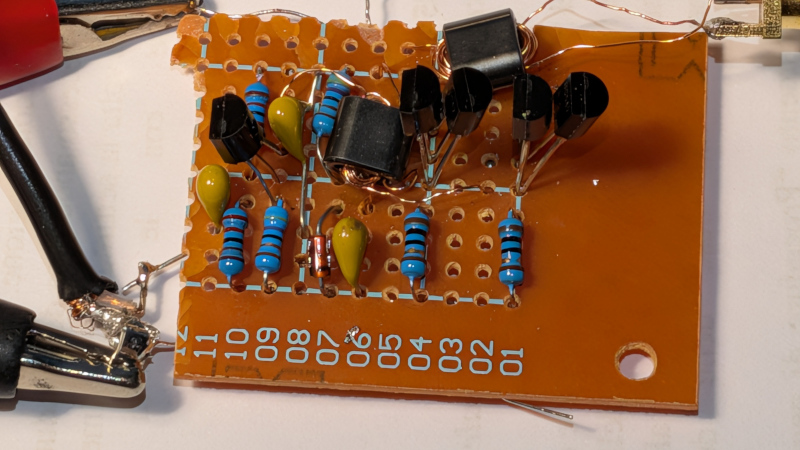
When building a radio transmitter, unless it’s a very small one indeed, there’s a need for an amplifier before the antenna. This is usually referred to as the power amplifier, or PA. How big your PA is depends on your idea of power, but at the lower end of the power scale a PA can be quite modest. QRP, as lowe power radio is referred to, has a transmit power in the miliwatts or single figure watts. [Guido] is here with a QRP PA that delivers about a watt from 1 to 30 MHz, is made from readily available parts, and costs very little.

Inspired by a circuit from [Harry Lythall], the prototype is built on a piece of stripboard. It’s getting away with using those cheap transistors without heatsinking because it’s a class C design. In other words, it’s in no way linear; instead it’s efficient, but creates harmonics and can’t be used for all modes of transmission. This PA will need a low-pass filter to avoid spraying the airwaves with spurious emissions, and on the bands it’s designed for, is for CW, or Morse, only.

We like it though, as it’s proof that building radios can still be done without a large bank balance. Meanwhile if the world of QRP interests you, it’s something we have explored in the past.

Simple D-STAR Transceiver Uses Inexpensive Hardware

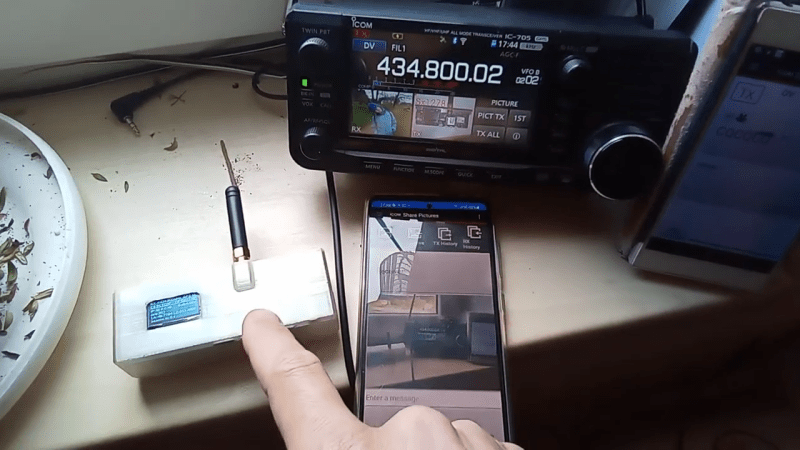
[Yeckel] recently put the finishing touches on an ambitious implementation of a simple D-STAR (Digital Smart Technologies for Amateur Radio) transceiver using some very accessible and affordable hardware. The project is D-StarBeacon, and [Yeckel] shows it working on a LilyGO TTGO T-Beam, an ESP32-based development board that includes a SX1278 radio module and GPS receiver. It even serves a web interface for easy configuration.

What is D-STAR? It’s a protocol used by radio operators for voice that also allows transmitting low-speed data, such as short text messages or GPS coordinates. While voice is out of scope for [Yeckel]’s project (more on that in a moment) it can do all the rest, including send images. That makes beacon-type functions possible on inexpensive hardware, instead of requiring a full-blown radio.

As mentioned, voice is a big part of D-STAR. While [Yeckel] was able to access the voice data, attempts to decode it were unsuccessful. A valiant effort, but we suppose voice decoding isn’t terribly relevant to beacon-type operations like transmitting APRS (Automatic Packet Reporting System).

So far as [Yeckel] is aware, D-StarBeacon is currently the only open-source implementation of a D-STAR radio available on the internet, which is pretty interesting. We’ve seen projects that touch indirectly on D-STAR, but nothing like this.

Watch it go through its paces in the video embedded below. Since the T-Beam is just a microcontroller development board, the user interface comes from an Android app on a mobile phone, which is why you see a phone in the video.